


Math Education in the Age of AI: From Grading Answers to Understanding Student Progress
Educational institutions around the world are grappling with how to respond. One thing is clear: AI is here to stay. It cannot be ignored, and it is forcing institutions to rethink how mathematics is taught, practiced, supported, and assessed.
One response is to suppress the use of LLMs and revert to paper assignments. That may address some immediate concerns, but it cannot be the whole answer. AI will play a major role in students’ futures, and we have a responsibility to prepare them for that world. It also misses a larger opportunity: used thoughtfully, AI can become a catalyst for improving student success rates in mathematics.


For as long as we can remember, assessment has been largely based on students producing measurable outputs. They complete assignments, quizzes, and exams, which are evaluated based on whether the answers are correct. Sometimes, partial marks are awarded for intermediate results. These results flow into grades, but they also serve another important purpose: they help instructors assess student progress, identify gaps, and course-correct before final exams.
That model is now fundamentally broken.
Students can turn to generative AI tools like ChatGPT to get fully worked solutions to assignments. They can take a picture of an online quiz, get an answer, and submit it as their own. Most students realize they are not really learning math this way. They know that the only way to learn math is by doing math. They understand that struggling through a difficult assignment is part of the learning process. But when deadlines are looming and term pressure is building, it becomes all too easy to take a shortcut through the work. They resolve to come back later and study the material properly. Too often, later never happens.
For instructors, this creates a different problem. The quiz results look strong, and students appear to be prepared. The moment of reckoning comes with the midterm, when hidden learning gaps become visible, often too late to address them effectively. Students are frustrated, and instructors have fewer opportunities to intervene before those gaps affect students’ progress in the course.
The impact of dropping success rates in mathematics extends across departments, programs, and the institution as a whole. When students cannot succeed in their math courses, they may lose momentum, switch programs, or leave the institution altogether. In fact, research has shown that success in first-year mathematics is one of the strongest predictors of student retention, particularly in STEM pathways.¹ ²
Even students who pass the first-year hurdle may struggle later if they lack a strong understanding of the fundamentals. This does not affect math departments alone. Many STEM and non-STEM programs depend on students being able to apply mathematics with confidence, and gaps in understanding can create barriers to success well beyond the first-year math course.
Assessment has long been one of the primary ways instructors identify and address gaps before they become larger barriers. In the age of AI, that model no longer works. Correct answers can no longer be treated as reliable evidence of understanding without more context about how students arrived at them. We need to fundamentally rethink how we assess and support student progress in an AI world.
Looking beyond the final answer means paying closer attention to the process students follow as they work through a problem: where they move confidently, where they get stuck, and how they find their way forward. Did they try multiple examples, engage with the activity, and explore around the margins? Now more than ever, these are the signals of learning we need to pay close attention to. None of this can be adequately captured by traditional assessment systems alone.
Observing students’ problem-solving process restores the visibility that AI took from us: areas of weakness, subjects of confusion, frequently misunderstood concepts, and learning gaps. With a clearer picture of how students are working, instructors can intervene earlier and reinforce difficult concepts in class or TA sessions, while learning centers and student success teams can provide targeted support where it will have the greatest impact.
None of this will prevent students from turning to AI tools, nor should the goal be simply to prevent all AI use. The difference is that we can now see how and when those tools are being used, and what that use may reveal about student understanding. If students arrive at the correct answer on an online quiz, but the data shows that many of them relied on AI for key steps, that is not just a concern about academic integrity. It is a learning signal. It tells us where students may need more instruction, practice, or support. The use of AI tools becomes in itself a signal that helps us understand where students struggle and where we need to direct our support.
In addition to all of this, AI is a wake-up call about which skills will truly be important to our students’ long-term success. In an environment where answers are cheap and immediate, critical thinking is more important than ever. Before tackling a problem, we need to make sure we understand the context and assumptions. When presented with a solution, we need to be able to evaluate its plausibility and relevance. Acquiring these skills is not a given, and teaching methodologies and content will need to continue to evolve. We need to pose problems that encourage independent thinking and exploration, and have students truly engage with the material. Once again, the educational focus has to shift towards the process students engage in, rather than focusing on what is produced as output.
The AI ecosystem is complex and fragmented. Many voices are competing for attention, each claiming to have a solution. The truth is that, as a community, we are still learning how to respond to this new reality.
What we do know is that student AI use is inevitable. We also know that institutions need practical ways to make mathematics learning more active, more visible, and more responsive to student needs. Engaging interactive materials are essential. So are analytics that reveal meaningful patterns in student activity and AI use.
The challenge for instructors and institutions is how to make this shift in practice. Many existing tools and processes were designed around assignments, quizzes, and final answers. They were not built to show how students are working, where they are struggling, or how AI is shaping the learning process. They also do not always provide the interactive experiences or targeted resources students need to build understanding once those gaps become visible. New approaches are needed to make mathematics learning more observable, more active, and more responsive.
Maple has helped educators for more than four decades to make mathematics active, visual, exploratory, and computational. In the age of AI, that foundation matters more than ever. Students need opportunities to build understanding by doing mathematics, and educators need better ways to see how that understanding is developing.
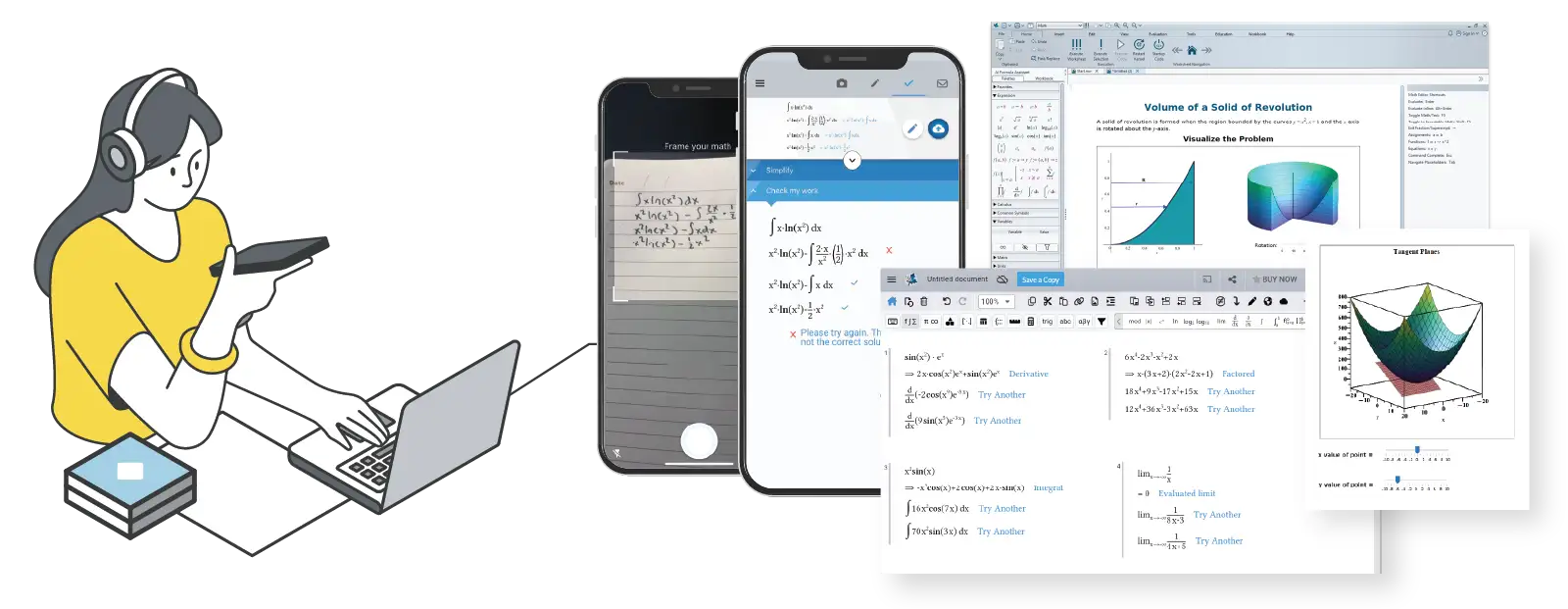
Built on Maple, the Maplesoft Math Success Platform extends this work with analytics, AI-driven insights, targeted resources, and tools across desktop, mobile, and web.
The Math Success Platform helps institutions move beyond answer-based assessment by making the student journey visible. Instructors and learning support teams can see how students are practicing, where they are getting stuck, and when they may be relying on AI instead of developing understanding.
The platform also helps instructors create the kinds of learning experiences students need in the age of AI: interactive activities that ask them to explore, visualize, practice, and reason through mathematics instead of simply arriving at an answer.
Those insights from student activity and AI use can then be used to adapt instruction, guide TA sessions, recommend targeted practice, and provide resources where they are most needed. This matters because students often struggle when they are working on their own, between classes, appointments, and office hours. Timely, targeted support can help them keep practicing, build confidence, and address small gaps before they become larger barriers.
For institutions, the advantages are clear. Increasing math success rates means more students persist into subsequent terms, remain in their chosen programs, and ultimately graduate. The return on investment is straightforward: for many institutions, retaining even one or two students who might otherwise have dropped out can have a positive impact on the bottom line.
The benefits do not stop there. Most educational institutions have invested significantly in online assessment systems. As we saw above, those systems no longer deliver the same insight on their own, because correct answers are no longer enough to show what students understand. The Math Success Platform works alongside these systems, helping them deliver value once more by adding visibility into the student journey.
Learning centers and student success teams also need to adapt to fulfill their mission of student success. Students are often reluctant to seek in-person help, even when they need support more than ever. The Math Success Platform extends support beyond scheduled appointments and gives learning support teams deeper insight into where students are struggling, enabling them to recommend targeted practice and interventions.

Success in math is crucial for students’ immediate and long-term academic success. Math education is at a crossroads, and we need to adapt to a world where AI is ubiquitous, answers are easy to obtain, and students are often tempted to take shortcuts that do not further their learning.
Shifting from answer-driven assessment to observing and supporting students on their individual learning journeys seems inevitable. That shift also requires different kinds of learning experiences: ones that ask students to engage actively with mathematics, build understanding by doing the work, and develop the judgment to use AI thoughtfully. It also requires better ways to provide support when students struggle, before small gaps become larger barriers.
Putting these principles into practice will itself be a journey. We will continue to learn and adapt. What matters now is taking the first steps: helping students build stronger mathematical foundations, giving educators better visibility into student progress, and preparing students for a world where AI will be part of how they learn, work, and solve problems.
1. Nunnery, J. A., & Mathies, C. (2026). Rethinking DFW in gateway mathematics: Preserved, disrupted, and dissipated momentum pathways to student retention. Innovative Higher Education. https://doi.org/10.1007/s10755-026-09896-3
2. Kopparla, M. (2019). Role of mathematics in retention of undergraduate STEM majors: A meta-analysis. Journal of Mathematics Education, 12(1), 107–122. https://journalofmathed.scholasticahq.com/article/122572-role-of-mathematics-in-retention-of-undergraduate-stem-majors-a-metaanalysis