


Maple
Leistungsfähige intuitive Mathematiksoftware
• Maple für Akademiker • Maple für Studenten • Maple Learn • Maple Calculator App • Maple für Industrie und Behörden • Maple for Individuals
Erweiterungen für Maple
• Books & Studienführer • Maple Toolboxen • MapleNet • Kostenloser Maple-Player
Math Success Platform
Mathe-Erfolg im Zeitalter der KI

Maple Flow
Engineering calculations & documentation
• Maple Flow • Maple Flow Migration Assistant
MapleSim
Modellierung auf Systemebene
• MapleSim • MapleSim for Web Converting Systems • MapleSim für Digitale Zwillinge • MapleSim für Akademiker • Erweiterte Bibliotheken für Spezialanwendungen • MapleSim Insight
Maple MCP
Das mathematik-plugin für ihr LLM

Beratende Dienstleistungen
• Ingenieurstechnische Dienstleistungen • Produktschulung • Turnkey Solutions
Produkte zur Online-Ausbildung
Suchen Sie Maple T.A. oder Möbius?Diese Produkte werden nun von unserem Technologiepartner DigitalEd angeboten. Mehr erfahren.


 and
 are tensors, then in
 ,
 is just dummy, therefore
 is a well defined object. The new design automatically maps input like
 into
 .





 repeated more than once, therefore none of its occurrences got automatically transformed into contravariant in the output, and Check detects the problem interrupting with an error message


 respectively representing angular and linear momentum


 , while the right-hand side has two dummy indices
 and

, `*`(p[c]))), all)](Physics/Physics_41.gif)


 we can now take the square of
 directly, and the dummy indices on the right-hand side are automatically handled, there is now no need to manually substitute the repeated indices to avoid their collision
, `*`(p[c]))), 2)](Physics/Physics_46.gif)
![Typesetting:-mprintslash([`*`(`^`(L[a], 2)) = `*`(Physics:-LeviCivita[a, b, c], `*`(X[b], `*`(p[c], `*`(Physics:-LeviCivita[a, d, e], `*`(X[d], `*`(p[e]))))))], [`*`(`^`(L[a], 2)) = `*`(Physics:-LeviC...](Physics/Physics_47.gif)

, `*`(p[c], `*`(Physics:-LeviCivita[a, d, e], `*`(Physics:-SpaceTimeVector[d](X), `*`(p[e])))))), all)](Physics/Physics_49.gif)


 and
 , and can used beyond Physics.

 ;


 are Hermitian operators
 commute between each other
 are the differentiation variables of the corresponding (differential) operators
 but do not tell what is the form of the operators


 is a smooth function, the idea is to apply the commutator
 to an arbitrary ket of the Hilbert space
 , perform the operation explicitly after setting a differential operator representation for
 , and from there get the commutation rule between
 and
 .



 ,
 and the ket
 are operands in the products above and that they do not commute: we indicated that the coordinates
 are the differentiation variables of
 . This emulates what we do when computing with these operators with paper and pencil, where we represent the application of a differential operator as a product operation.


 , the application of
 is not expanded: at this point nothing is known about
 , it is not necessarily a linear operator. In the Quantum Mechanics problem at hands, however, it is. So give now the operator
 an explicit representation as a linear vectorial differential operator (we use the inert form %Nabla,
 , to be able to proceed with full control one step at a time)


 and simplify taking into account the algebra rules for the coordinate operators



 is true for all
 , this ket can be removed from both sides of the equation. One can do that either taking coefficients or multiplying by the "formal inverse" of this ket, arriving at the (expected) form of the commutation rule between
 and







![Typesetting:-mprintslash([{Physics:-Dgamma[mu], P[m], Physics:-Psigma[mu], X[mu], Physics:-d_[mu], Physics:-g_[mu, nu], Physics:-gamma_[a, b], Physics:-KroneckerDelta[mu, nu], Physics:-LeviCivita[alph...](Physics/Physics_127.gif)


 is going to be applied
, P[n]), Physics:-Ket(psi, x, y, z)) = expand(Physics:-`*`(Physics:-Commutator(Physics:-SpaceTimeVector[m](X), P[n]), Physics:-Ket(psi, x...](Physics/Physics_131.gif)

 ;
, P[n]), Physics:-Ket(psi, x, y, z)) = Library:-ApplyProductsOfDifferentialOperators(Physics:-`*`(Physics:-Commutator(Physics:-SpaceTimeV...](Physics/Physics_134.gif)

 , here again using the inert
 to keep control of the computations step by step
))))) end proc](Physics/Physics_138.gif)
![Typesetting:-mprintslash([P[n] := proc (f) options operator, arrow; `+`(`-`(Physics:-`*`(I, `ℏ`, %d_[n](f)))) end proc], [proc (f) options operator, arrow; `+`(`-`(Physics:-`*`(I, `ℏ`, %d_[n...](Physics/Physics_139.gif)
, P[n]), Physics:-Ket(psi, x, y, z)) = `+`(Physics:-`*`(Physics:-SpaceTimeVector[m](X), P[n](Physics:-Ket(psi, x, y, z))), `-`(P[n](Physi...](Physics/Physics_141.gif)

 and simplify taking into account Einstein's rule for repeated indices
, P[n]), Physics:-Ket(psi, x, y, z)) = `+`(`-`(`*`(`+`(I), `*`(`ℏ`, `*`(Physics:-`*`(Physics:-SpaceTimeVector[m](X), ...](Physics/Physics_144.gif)

 is arbitrary, we can take coefficients (or multiply by the formal Inverse of this ket as done in the previous section). For illustration purposes, we use Coefficients and note how it automatically expands the commutator
, P[n]), Physics:-Ket(psi, x, y, z)) = `*`(I, `*`(`ℏ`, `*`(Physics:-g_[m, n], `*`(Physics:-Ket(psi, x, y, z))))), Ket(p...](Physics/Physics_147.gif)
![Typesetting:-mprintslash([`+`(Physics:-`*`(X[m], P[n]), `-`(Physics:-`*`(P[n], X[m]))) = `*`(I, `*`(`ℏ`, `*`(Physics:-g_[m, n])))], [`+`(Physics:-`*`(Physics:-SpaceTimeVector[m](X), P[n]), `-`(Ph...](Physics/Physics_148.gif)
 and

, P[n]), `-`(Physics:-`*`(P[n], Physics:-SpaceTimeVector[m](X)))) = `*`(I, `*`(`ℏ`, `*`(Physics:-g_[m, n]))), [P[n], X[m]], us...](Physics/Physics_151.gif)

, P[n]) = `*`(I, `*`(`ℏ`, `*`(Physics:-g_[m, n]))))))](Physics/Physics_153.gif)


 , redefine the tensor
 explicitly indicating its Cartesian component

![Typesetting:-mprintslash([{Physics:-Dgamma[mu], P[m], Physics:-Psigma[mu], X[mu], Physics:-d_[mu], Physics:-g_[mu, nu], Physics:-gamma_[a, b], Physics:-KroneckerDelta[mu, nu], Physics:-LeviCivita[alph...](Physics/Physics_161.gif)
, P[n]) = `*`(I, `*`(`ℏ`, `*`(Physics:-g_[m, n]))))))](Physics/Physics_162.gif)






![Typesetting:-mprintslash([Physics:-EnergyMomentum[mu, nu] = `+`(`/`(`*`(`/`(1, 8), `*`(Physics:-Einstein[mu, nu])), `*`(Pi))), Physics:-EnergyMomentum[`~mu`, `~nu`] = (Matrix(4, 4, {(1, 1) = Typesetti...](Physics/Physics_182.gif)


 is related to Newton’s constant.
 , use for instance the inert version of the covariant derivative operator D_ and the TensorArray command


 = 0)](Physics/Physics_190.gif)


 = 0](Physics/Physics_195.gif) ).
 to be constant energy (i.e. no functionality) and the flux density
 and stress
 tensors depending on
 For this purpose, use the new option minimizetensorcomponents to make explicit the symmetry of the stress tensor


![Typesetting:-mprintslash([{Physics:-D_[mu], Physics:-Dgamma[mu], Physics:-Psigma[mu], Physics:-Ricci[mu, nu], Physics:-Riemann[mu, nu, alpha, beta], S[mu], Physics:-Weyl[mu, nu, alpha, beta], X[mu], P...](Physics/Physics_203.gif)
 is now explicit in that its matrix form is symmetric


 end if elif nu = 4 then S[mu](X) else sigma[mu, nu](X) end if end proc)](Physics/Physics_211.gif)




 with these components


![Typesetting:-mprintslash([{Physics:-D_[mu], Physics:-Dgamma[mu], Physics:-Psigma[mu], Physics:-Ricci[mu, nu], Physics:-Riemann[mu, nu, alpha, beta], S[mu], Physics:-Weyl[mu, nu, alpha, beta], X[mu], P...](Physics/Physics_219.gif)


 , use again the inert version of the covariant derivative operator D_ and the TensorArray command


 = 0))](Physics/Physics_225.gif)

 and stress
 tensors as a set, and solve it for them



, tau))), `*`(`^`(k, 2)))), `/`(`*`(`+`(`*`(2, `*`(r, `*`(S[2](X)))), `*`(`^`(r, 2), `*`(diff(S[2](X), r))))), `*`(`^`(k, 2))), `/`(`*`(diff(S[3](X)...](Physics/Physics_237.gif)


 and stress

 = S[1](X), S[2](X) = S[2](X), S[3](X) = `/`(`*`(`+`(Int(`+`(`*`(`^`(r, 2), `*`(diff(S[1](X), tau), `*`(sin(theta)))), `-`(`*`(sin(theta), `*`(diff(S[2](X), r), `*`(`^`(r, 2)))))), the...](Physics/Physics_255.gif)





 is antisymmetric,




 do not automatically reflect that, it is necessary to use the simplifier of the Physics package, Simplify.


 we do not see the elements of the diagonal equal to nor the lower-left triangle equal to the upper-right triangle but with a different sign:


 and
 are automatically equal to 0 without having to use Simplify


 becomes equal to
 .








 , its output is ordered, first the symmetric then the antisymmetric properties


 in the definition of tensors with symmetries





 and
 , the first one to have the number of tensor components directly reflected in the names of the components, the second one to redefine only one of these components

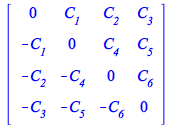


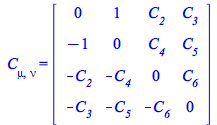








 gets applied


![Typesetting:-mprintslash([{A[mu], Physics:-D_[mu], Physics:-Dgamma[mu], Physics:-Psigma[mu], Physics:-Ricci[mu, nu], Physics:-Riemann[mu, nu, alpha, beta], Physics:-Weyl[mu, nu, alpha, beta], X[mu], P...](Physics/Physics_351.gif)


 is a tensor, so is
 , and the latter is typeset as the former, only in gray, with copy & paste working, reproducing




)](Physics/Physics_361.gif)

) = Physics:-D_[mu](A[nu](X), [X]))](Physics/Physics_363.gif)

) = `+`(Physics:-d_[mu](A[nu](X), [X]), `-`(`*`(Physics:-Christoffel[`~alpha`, mu, nu], `*`(A[alpha](X))))))](Physics/Physics_365.gif)

) = `+`(Physics:-d_[mu](A[nu](X), [X]), `-`(`*`(%Christoffel[`~alpha`, mu, nu], `*`(A[alpha](X))))), simplifier = simplify); -1](Physics/Physics_367.gif)


, [X]), `/`(`*`(`+`(`-`(r), `*`(2, `*`(m))), `*`(m, `*`(A[1](X)))), `*`(`^`(r, 3)))) = `+`(diff(A[4](X), t), `-`(`*`(%Christoffel[`~1`, 4, 4], `*`(A[1](X)))), `-`(`*`(%Christof...](Physics/Physics_370.gif)


![Typesetting:-mprintslash([Physics:-`*`(Physics:-Dgamma[mu], Physics:-Dgamma[`~lambda`], Physics:-Dgamma[`~nu`], Physics:-Dgamma[`~rho`], Physics:-Dgamma[`~mu`])], [Physics:-`*`(Physics:-Dgamma[mu], Ph...](Physics/Physics_379.gif)

![Typesetting:-mprintslash([`+`(`-`(`*`(2, `*`(Physics:-`*`(Physics:-Dgamma[`~rho`], Physics:-Dgamma[`~nu`], Physics:-Dgamma[`~lambda`])))))], [`+`(`-`(`*`(2, `*`(Physics:-`*`(Physics:-Dgamma[`~rho`], P...](Physics/Physics_381.gif)


![Typesetting:-mprintslash([`+`(`*`(2, `*`(Physics:-`*`(Physics:-Dgamma[`~sigma`], Physics:-Dgamma[`~lambda`], Physics:-Dgamma[`~nu`], Physics:-Dgamma[`~rho`]))), `*`(2, `*`(Physics:-`*`(Physics:-Dgamma...](Physics/Physics_385.gif)
 follows the Landau, Bogoliubov and Tong books on quantum fields, so for the default signature


 routine, we have


 routine takes into account the possibly Euclidean character of spacetime, also the possible values of the signature: (- - - +), (+ - - -), (+ + + -) and (- + + +), and uses formulas valid for the three representations: standard, chiral and majorana.

![Typesetting:-mprintslash([`𝕀` := matrix([[1, 0, 0, 0], [0, 1, 0, 0], [0, 0, 1, 0], [0, 0, 0, 1]])], [array( 1 .. 4, 1 .. 4, [( 1, 4 ) = (0), ( 2, 3 ) = (0), ( 4, 1 ) = (0), ( 2, 4 ) = (0), ( 3, 3...](Physics/Physics_394.gif)


![Typesetting:-mprintslash([matrix([[1, 0, 0, 0], [0, 1, 0, 0], [0, 0, 1, 0], [0, 0, 0, 1]])], [array( 1 .. 4, 1 .. 4, [( 1, 4 ) = (0), ( 2, 3 ) = (0), ( 4, 1 ) = (0), ( 2, 4 ) = (0), ( 3, 3 ) = (1), ( ...](Physics/Physics_400.gif)


![Typesetting:-mprintslash([Psi := matrix([[psi[1]], [psi[2]], [psi[3]], [psi[4]]])], [array( 1 .. 4, 1 .. 1, [( 4, 1 ) = (psi[4]), ( 2, 1 ) = (psi[2]), ( 1, 1 ) = (psi[1]), ( 3, 1 ) = (psi[3]) ] )])](Physics/Physics_412.gif)


 routine





![Typesetting:-mprintslash([matrix([[psi[1]], [psi[2]], [psi[3]], [psi[4]]])], [array( 1 .. 4, 1 .. 1, [( 4, 1 ) = (psi[4]), ( 2, 1 ) = (psi[2]), ( 1, 1 ) = (psi[1]), ( 3, 1 ) = (psi[3]) ] )])](Physics/Physics_429.gif)

![Typesetting:-mprintslash([Physics:-`.`(matrix([[1, 0, 0, 0], [0, 1, 0, 0], [0, 0, 1, 0], [0, 0, 0, 1]]), matrix([[psi[1]], [psi[2]], [psi[3]], [psi[4]]]))], [Physics:-`.`(array( 1 .. 4, 1 .. 4, [( 1, ...](Physics/Physics_431.gif)








![Typesetting:-mprintslash([e2 := Physics:-`*`(Physics:-Dgamma[mu], Physics:-Dgamma[`~lambda`], Physics:-Dgamma[`~nu`], Physics:-Dgamma[`~mu`])], [Physics:-`*`(Physics:-Dgamma[mu], Physics:-Dgamma[`~lam...](Physics/Physics_451.gif)

![Typesetting:-mprintslash([e3 := Physics:-`*`(Physics:-Dgamma[mu], Physics:-Dgamma[`~lambda`], Physics:-Dgamma[`~nu`], Physics:-Dgamma[`~rho`], Physics:-Dgamma[`~mu`])], [Physics:-`*`(Physics:-Dgamma[m...](Physics/Physics_453.gif)




![Typesetting:-mprintslash([T := `+`(Physics:-`*`(Physics:-Dgamma[1], Physics:-Dgamma[`~1`]), Physics:-`*`(Physics:-Dgamma[2], Physics:-Dgamma[`~2`]), Physics:-`*`(Physics:-Dgamma[3], Physics:-Dgamma[`~...](Physics/Physics_459.gif)



 using the new
 routine

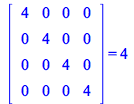

![Typesetting:-mprintslash([Physics:-`*`(Physics:-Dgamma[mu], Physics:-Dgamma[`~nu`], Physics:-Dgamma[`~mu`]) = `+`(`-`(`*`(2, `*`(Physics:-Dgamma[`~nu`]))))], [Physics:-`*`(Physics:-Dgamma[mu], Physics...](Physics/Physics_473.gif)

![Typesetting:-mprintslash([`+`(Physics:-`*`(Physics:-Dgamma[1], Physics:-Dgamma[`~nu`], Physics:-Dgamma[`~1`]), Physics:-`*`(Physics:-Dgamma[2], Physics:-Dgamma[`~nu`], Physics:-Dgamma[`~2`]), Physics:...](Physics/Physics_475.gif)






![Typesetting:-mprintslash([`+`(Physics:-`*`(Physics:-Dgamma[1], Physics:-Dgamma[`~lambda`], Physics:-Dgamma[`~nu`], Physics:-Dgamma[`~1`]), Physics:-`*`(Physics:-Dgamma[2], Physics:-Dgamma[`~lambda`], ...](Physics/Physics_485.gif)



![Typesetting:-mprintslash([Physics:-`*`(Physics:-Dgamma[mu], Physics:-Dgamma[`~lambda`], Physics:-Dgamma[`~nu`], Physics:-Dgamma[`~rho`], Physics:-Dgamma[`~mu`]) = `+`(`-`(`*`(2, `*`(Physics:-`*`(Physi...](Physics/Physics_489.gif)

![Typesetting:-mprintslash([Physics:-`*`(Physics:-Dgamma[mu], Physics:-Dgamma[`~lambda`], Physics:-Dgamma[`~nu`], Physics:-Dgamma[`~rho`], Physics:-Dgamma[`~sigma`], Physics:-Dgamma[`~mu`]) = `+`(`*`(2,...](Physics/Physics_491.gif)


![Typesetting:-mprintslash([`*`(A[nu], `*`(Physics:-`*`(Physics:-Dgamma[mu], Physics:-Dgamma[`~nu`], Physics:-Dgamma[`~mu`]))) = `+`(`-`(`*`(2, `*`(A[`~nu`], `*`(Physics:-Dgamma[nu])))))], [`*`(A[nu], `...](Physics/Physics_496.gif)

![Typesetting:-mprintslash([`*`(A[nu], `*`(B[lambda], `*`(Physics:-`*`(Physics:-Dgamma[mu], Physics:-Dgamma[`~lambda`], Physics:-Dgamma[`~nu`], Physics:-Dgamma[`~mu`])))) = `+`(`*`(4, `*`(B[`~nu`], `*`(...](Physics/Physics_498.gif)




 change sign when compared with corresponding ones from
 while the timelike component remains unchanged






 and


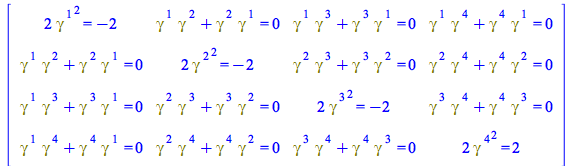



![Typesetting:-mprintslash([e2 := Physics:-`*`(Physics:-Dgamma[mu], Physics:-Dgamma[`~lambda`], Physics:-Dgamma[`~nu`], Physics:-Dgamma[`~mu`])], [Physics:-`*`(Physics:-Dgamma[mu], Physics:-Dgamma[`~lam...](Physics/Physics_533.gif)

![Typesetting:-mprintslash([e3 := Physics:-`*`(Physics:-Dgamma[mu], Physics:-Dgamma[`~lambda`], Physics:-Dgamma[`~nu`], Physics:-Dgamma[`~rho`], Physics:-Dgamma[`~mu`])], [Physics:-`*`(Physics:-Dgamma[m...](Physics/Physics_535.gif)


![Typesetting:-mprintslash([T := `+`(Physics:-`*`(Physics:-Dgamma[1], Physics:-Dgamma[`~1`]), Physics:-`*`(Physics:-Dgamma[2], Physics:-Dgamma[`~2`]), Physics:-`*`(Physics:-Dgamma[3], Physics:-Dgamma[`~...](Physics/Physics_541.gif)


![Typesetting:-mprintslash([Physics:-`*`(Physics:-Dgamma[mu], Physics:-Dgamma[`~nu`], Physics:-Dgamma[`~mu`]) = `+`(`-`(`*`(2, `*`(Physics:-Dgamma[`~nu`]))))], [Physics:-`*`(Physics:-Dgamma[mu], Physics...](Physics/Physics_545.gif)

![Typesetting:-mprintslash([`+`(Physics:-`*`(Physics:-Dgamma[1], Physics:-Dgamma[`~nu`], Physics:-Dgamma[`~1`]), Physics:-`*`(Physics:-Dgamma[2], Physics:-Dgamma[`~nu`], Physics:-Dgamma[`~2`]), Physics:...](Physics/Physics_547.gif)


![Typesetting:-mprintslash([`+`(Physics:-`*`(Physics:-Dgamma[1], Physics:-Dgamma[`~lambda`], Physics:-Dgamma[`~nu`], Physics:-Dgamma[`~1`]), Physics:-`*`(Physics:-Dgamma[2], Physics:-Dgamma[`~lambda`], ...](Physics/Physics_557.gif)







![Typesetting:-mprintslash([Physics:-`*`(Physics:-Dgamma[mu], Physics:-Dgamma[`~lambda`], Physics:-Dgamma[`~nu`], Physics:-Dgamma[`~rho`], Physics:-Dgamma[`~mu`]) = `+`(`-`(`*`(2, `*`(Physics:-`*`(Physi...](Physics/Physics_570.gif)

![Typesetting:-mprintslash([`+`(Physics:-`*`(Physics:-Dgamma[1], Physics:-Dgamma[`~lambda`], Physics:-Dgamma[`~nu`], Physics:-Dgamma[`~rho`], Physics:-Dgamma[`~1`]), Physics:-`*`(Physics:-Dgamma[2], Phy...](Physics/Physics_572.gif)
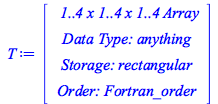
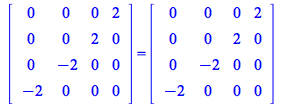
 , the spacetime components form an array 4x4x4 of 64 components, each of which is a matrix equation


![Typesetting:-mprintslash([`+`(Physics:-`*`(Physics:-Dgamma[1], Physics:-`^`(Physics:-Dgamma[`~1`], 4)), Physics:-`*`(Physics:-Dgamma[2], Physics:-`^`(Physics:-Dgamma[`~1`], 3), Physics:-Dgamma[`~2`]),...](Physics/Physics_577.gif)






![Typesetting:-mprintslash([Physics:-`*`(Physics:-Dgamma[mu], Physics:-Dgamma[`~lambda`], Physics:-Dgamma[`~nu`], Physics:-Dgamma[`~rho`], Physics:-Dgamma[`~sigma`], Physics:-Dgamma[`~mu`]) = `+`(`*`(2,...](Physics/Physics_587.gif)

![Typesetting:-mprintslash([`+`(Physics:-`*`(Physics:-Dgamma[1], Physics:-Dgamma[`~lambda`], Physics:-Dgamma[`~nu`], Physics:-Dgamma[`~rho`], Physics:-Dgamma[`~sigma`], Physics:-Dgamma[`~1`]), Physics:-...](Physics/Physics_589.gif)


![Typesetting:-mprintslash([`+`(Physics:-`*`(Physics:-Dgamma[1], Physics:-`^`(Physics:-Dgamma[`~1`], 5)), Physics:-`*`(Physics:-Dgamma[2], Physics:-`^`(Physics:-Dgamma[`~1`], 4), Physics:-Dgamma[`~2`]),...](Physics/Physics_593.gif)


 of
 .. ())](Physics/Physics_600.gif) constructions in a Minkowski spacetime can now be computed using
 .. ()), diff)](Physics/Physics_601.gif)
 to proceed also when
 is noncommutative by returning unevaluated. In this way one can afterwards define commutation rules such that derivative can be computed.
 when
 and
 are noncommutative but commute between themselves.
 and
 that belong to one and the same coordinate system always commute, even if
 and
 are quantum operators.
 set as a quantum operator that commutes with another quantum operator V, also commute with V.
 , a coordinate system vector, as a quantum operator. With that, automatically,
 , is of type noncommutative.
 now return a 3x3 matrix when
 are space indices.
 we now use
 , an upside down triangle that is slightly different from Nabla,
 used in Physics:-Vectors.
 for the Dagger of the SpaceTimeVector (any coordinate system defined through Setup or Coordinates).
 to Physics:-Library:-TensorComponent.